








Programming Agency: A Three-Day Workshop with Sarah Oppenheimer
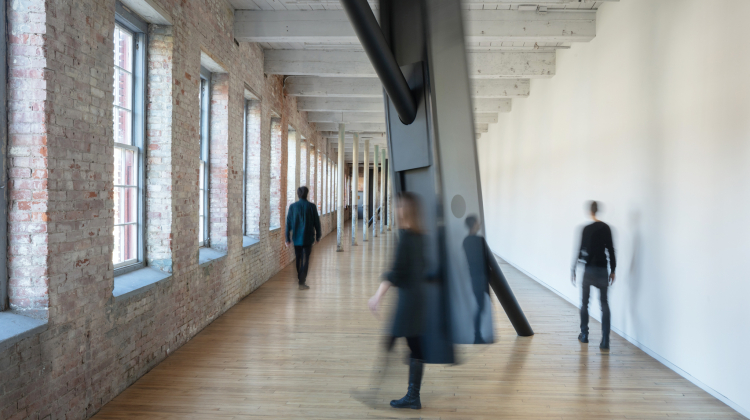
Sarah Oppenheimer, S-334473, 2019. Installation view: MASS MoCA, North Adams, MA, 2019. Photo: Richard Barnes
A workshop convened by artist Sarah Oppenheimer invites MIT community members into the research behind N-05001, the forthcoming percent-for-art commission for the Metropolitan Warehouse.
Convened by Sarah Oppenheimer
with special guests: Simon Jeger (Laboratory of Intelligent Systems EPFL, Lausanne); Christian Baas (automation programmer, Creative Conners); Paul Swagerman (filmmaker, photographer, designer); William Warren (Dept. of Cognitive and Psychological Sciences, Brown University); Jack Hilchey (principal designer, Folding Enterprises, NY)
Programming Agency is cohosted by the Met Commons at the MIT School of Architecture and Planning (SA+P), the MIT List Visual Arts Center, and the Art, Culture, and Technology (ACT) program at MIT.
Registration is now closed, but you may attend Sarah Oppenheimer's public lecture on January 29, 5pm.
Description
Programming Agency is a three-day workshop open to the MIT community presented by the Met Commons, the Met Warehouse's public-facing creative program. The workshop is convened by artist Sarah Oppenheimer, who was selected to realize N-05001, a new percent-for-art commission in MIT’s Metropolitan Warehouse (Building W41). Using N-05001 as a case study, the session will investigate how dynamic shifts in the architectural environment shape perceptions of social agency.
N-05001 will be grafted onto the Met’s architecture. Traveling along structural beams and moving between floors, the piece migrates through the building’s envelope. A glass column rises and falls along a cantilevered glass beam while a stainless-steel counterweight balances this asymmetric configuration. Hardwired into the building’s control system, N-05001’s movement responds to real-time occupancy data. Distributed sensors within designated spatial zones register human motion, translating individual actions—walking, pausing, gathering—into data signals that shape the artwork's axial paths. To challenge the perception that architectural space is static, N-05001 moves with intentional slowness. Occupants’ influence is real but deferred. As micro-events accumulate, choreographies unfold beyond immediate perception. N-05001 invites reconsideration of control itself: rather than seeking instant feedback, it expands a field of delayed reciprocity. Cause and effect are stretched across time and space.
Through engagement with models, discussions, and performative simulations, the workshop will explore how the ability to influence and shape one's environment is experienced across divergent materials and timescales. We will investigate how spatial orientation and optical flow influence perceptions of environmental interconnection and how sensate causal relationships between bodies moving at different temporal rhythms can be constructed. Our experiments will examine correlations between sensor signals and directional movement, with a specific focus on input from occupancy sensors hardwired into building infrastructure. By manipulating temporal and spatial feedback, we will attempt to uncover new forms of perceived interaction.
Experiments conducted in MIT’s motion capture studio will test our developed hypotheses on the relationship between sensing and cause and effect. The results will inform how the relationship between the building’s occupants and N-05001 is ultimately encoded.
Agenda
Thursday Jan 29
5 pm / ACT Cube—Sarah Oppenheimer Lecture (40min + Q+A)
Friday Jan 30
9–11:30am / ACT Cube—Inquiry and methods
- Met Warehouse Movement Analysis
- Introduction to computational methods: Simon Jeger
- Introduction to methodology. Simulation, perception of the sense of agency and temporal constraints: William Warren
12–1pm / Met Warehouse—Site tour for workshop participants
(walkthrough of sculpture location and placement of occupancy sensors)
1–2pm / Lunch Break
2–6pm / ACT Cube—Measurable variables
- Orientation and awareness of spatial change
- Change of environment position / Rate of change
- Change of viewing position / Rate of change
2:30–4:30pm / Design and review of analog / embodied “simulations"
4:30–6pm / Design of digital / Motion Capture “simulations”
Saturday Jan 31
9am–1pm / Motion Capture Simulations Immersion Lab—Virtual Simulations
1–2pm / Lunch Break
2–5pm / ACT Cube—final session: assessing observations, articulating conclusions
Participation
This workshop is open to MIT Community members only / the January 29, 5pm lecture is open to all.
Maximum workshop capacity: 20 participants
Registration is closed.
Please note that form submission does not guarantee participation.
This workshop will be documented through photos and video. By participating, you consent to being recorded.