








2025 Andrea Chegut Fellowship awarded
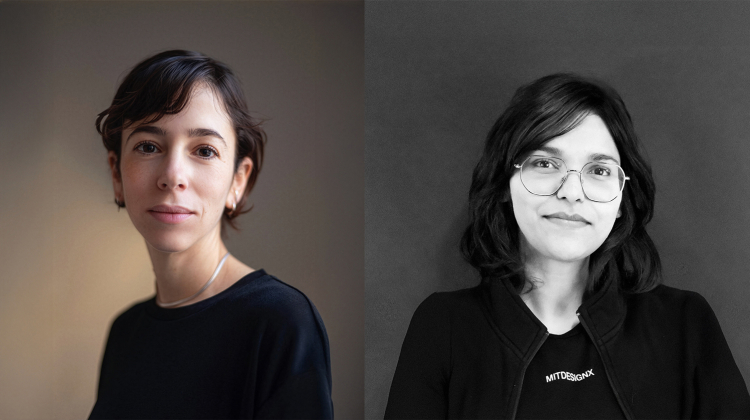
Nof Nathansohn (left) and Richa Vera Udayana were awarded Andrea Chegut Fellowships for 2025.
The fellowship was established to honor the life and work of Andrea Chegut, a research scientist and co-founder of the MIT Real Estate Innovation Lab and MITdesignX.
Two graduate students in the MIT School of Architecture and Planning have been awarded an Andrea Chegut Fellowship for the 2025-26 academic year: Nof Nathansohn, a PhD student studying computation in the Department of Architecture and Richa Vera Udayana, a Master of City Planning candidate in the Department of Urban Studies and Planning.
“This fellowship supports emerging innovators in the School of Architecture and Planning who work at the intersection of design, technology, and society by providing mentoring and resources for them to pursue projects they care deeply about,” says Svafa Grönfeldt, professor of the practice and faculty director of MITdesignX.
Nathansohn’s work asks the simple question: what if buildings could grow? An architect, researcher, and designer, she is exploring the convergence of material ecology, computational design, and regenerative fabrication. At the center of her practice is soil-and-seed 3D printing: robotic tools extrude locally sourced earth infused with seeds that germinate, root, and stabilize as plants grow through the material. Here, code does not dictate a final object — it encodes a process of becoming. Working with robots and soil side by side, Nathansohn is drawn to the tension between precision and uncertainty, between control and chance. She intends to design systems that invite nature in rather than seal it out — architectures that participate in ecological cycles rather than extract from them.
Richa is interested in spatializing social networks and information flows through communities using the burgeoning and decline of industrial activity as entry points for investigation. Focusing on the seemingly divergent contexts of rapidly forming manufacturing clusters in India and postindustrial “left-behind” regions in the United States, Richa’s research looks at how regional development is shaped under twin pressures: from above, the imposition (or withdrawal) of industry exerts massive—often largely exogenous—economic, political, social, and cultural forces on regions; concurrently, from below, the ways in which the residents of these regions receive, process, and wield information represent a force that may be equally potent in shaping regions but remains far less understood in regional development scholarship. This work arises from and speaks to Richa’s decade-long interdisciplinary career in journalism and industrial policy research.
The fellowship was established to offer financial support to SA+P graduate students who are interested in applying design to solve complex problems and make a positive impact on the human environment. This endowed fellowship honors the life and work of Andrea Chegut, a research scientist and co-founder of the MIT Real Estate Innovation Lab and MITdesignX.
-- Maria Iacobo