Occupancy

Ongoing Relations | Footprints | Labor and Trades | Migratory Desires | Polymaths
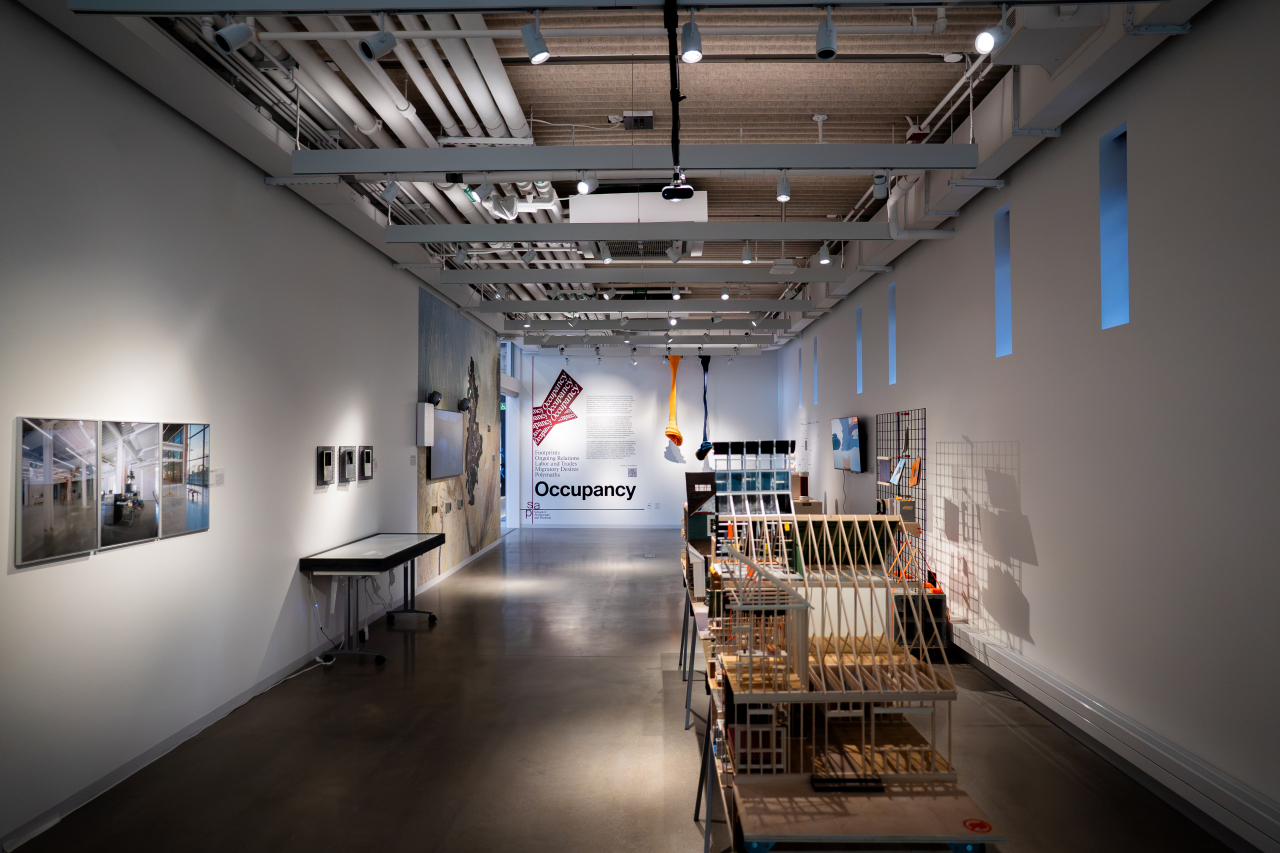
An inaugural all-school exhibition
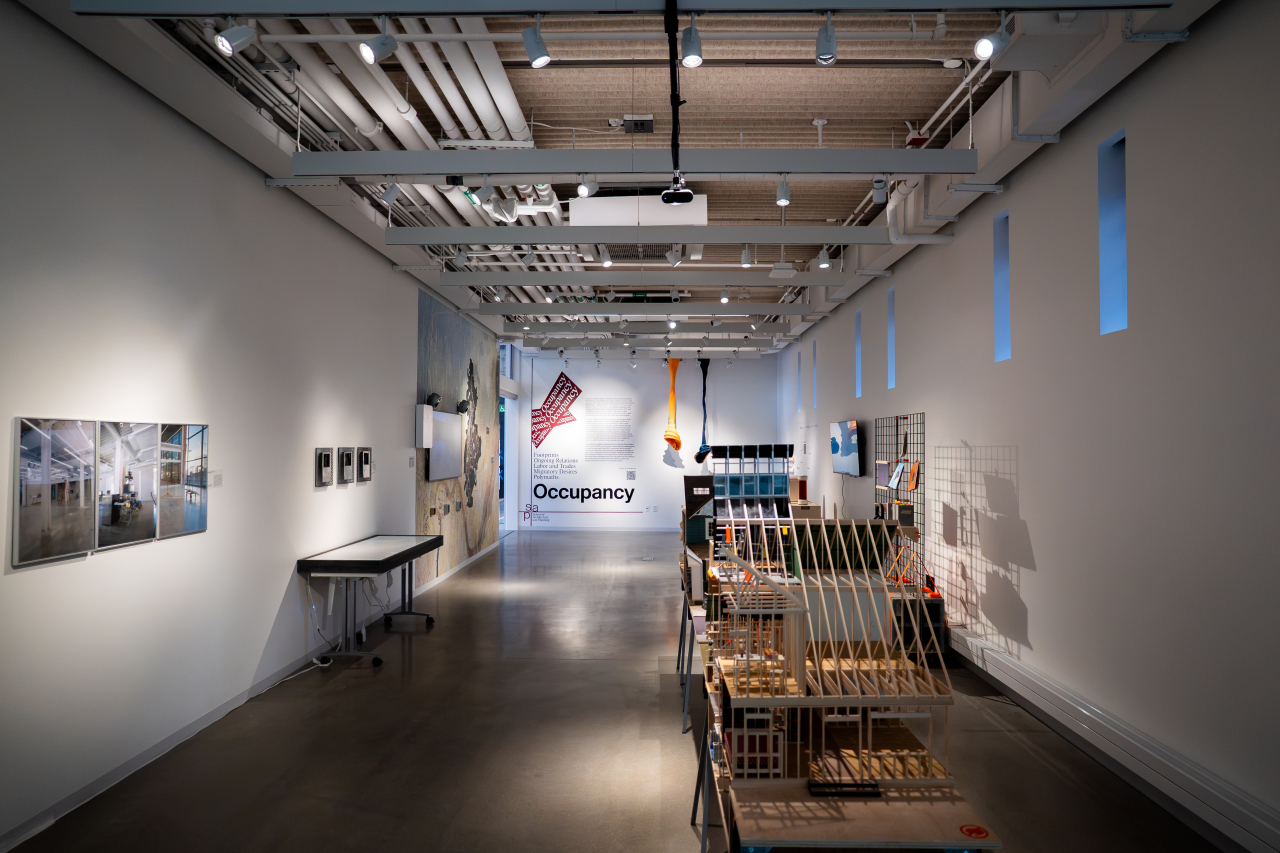
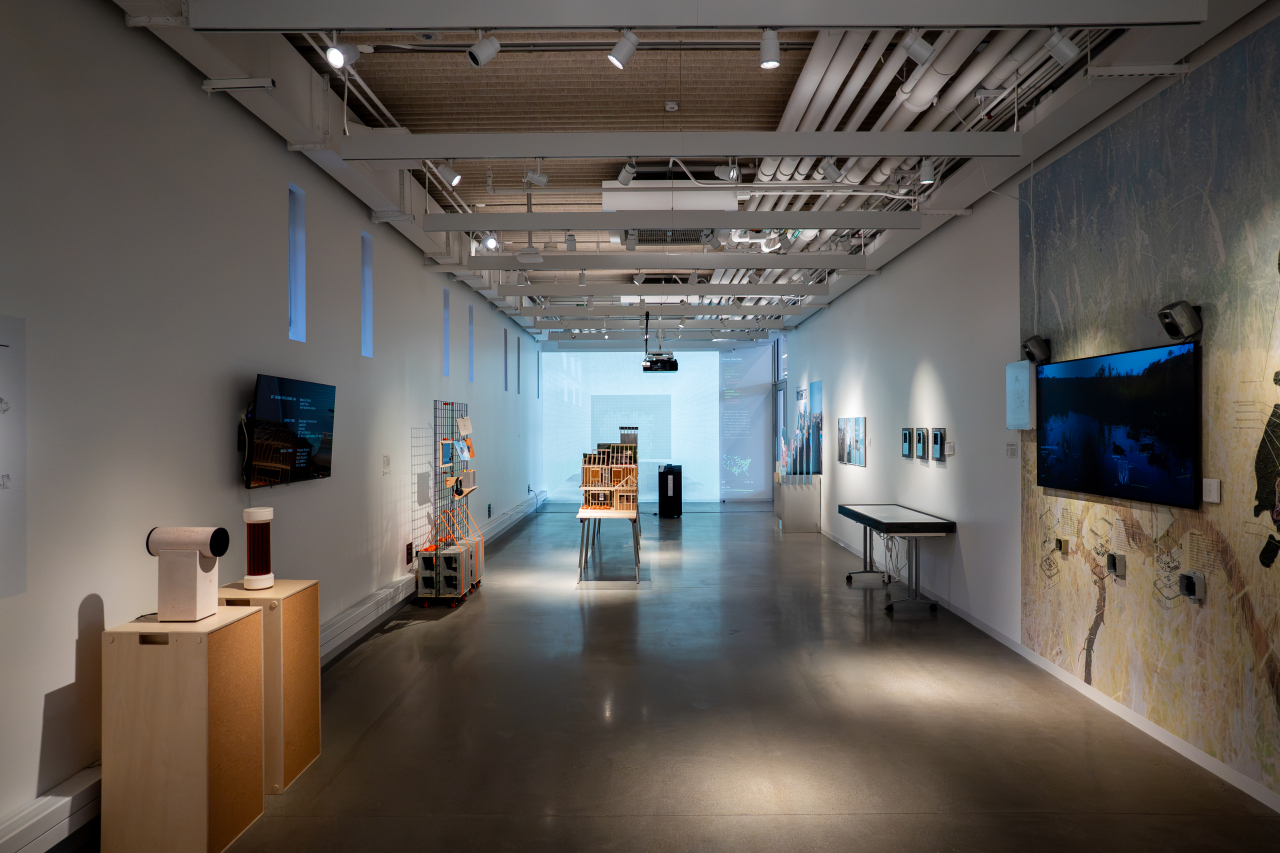
Organized around five themes – Ongoing Relations | Footprints | Labor and Trades | Migratory Desires | Polymaths – the exhibition celebrates the opening of the Metropolitan Storage Warehouse (the MET) and considers occupancy as a condition: how do we inhabit, shape, and form relationships with the places and people around us, and how do our stories intertwine with those who came before?
Occupancy presents key questions for our moment, asking how we inhabit the planet, inquiring into the many occupations that go into making a building habitable, charting human desires to migrate to better sites, and exploring ongoing relationships with communities. It draws inspiration from Rooms, the inaugural 1976 exhibition at MoMA PS1, in which artists filled the spaces of a former public school with installations, transforming the building into a new center for contemporary art. Here, the MET's public spaces become Commons: shared sites for exploring the transition from arrival to homecoming. Occupancy aims to highlight the unique possibilities that come with sharing a new home where scholars, architects, planners, artists, students, and designers can call and respond to intertwined questions about laying down roots. Whether looking to the past, casting a future, or both at once, the works in the exhibition invite viewers to reflect on what it means to make a space one's own.
This exhibition was produced collaboratively through an open call to the SA+P community, led by the MET Commons Committee, with curatorial stewardship by Caroline A. Jones, SA+P Associate Dean for Strategic Initiatives, and Mehveş Lelic, Head of Exhibitions and Programs for the MET Commons. Polymaths was produced by the Morningside Academy for Design (MAD) and curated by Roi Salgueiro Barrio.
List of Works
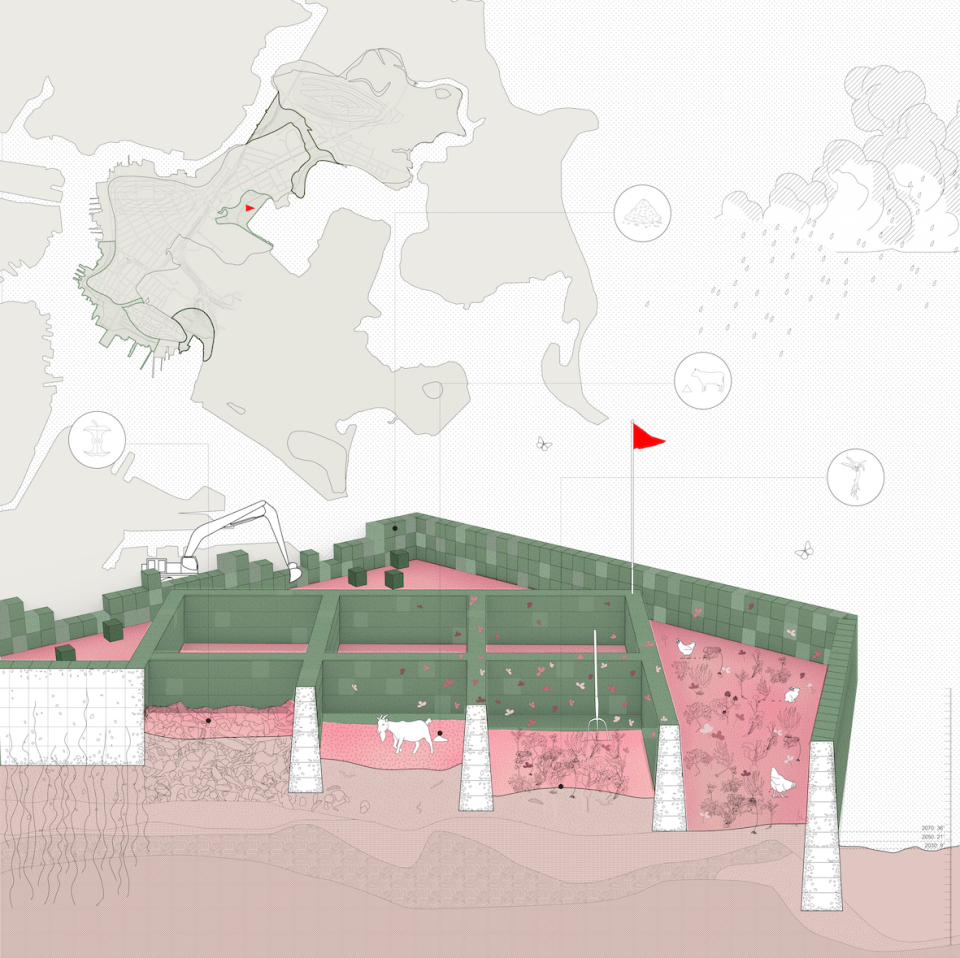
Sowing Worlds, 2026
Rania Ghosn
Assistant Professor,
Architecture;
DESIGN EARTH
El Hadi Jazairy
Associate Professor,
University of Michigan;
DESIGN EARTH
Contributors
Melissa Gutierrez Soto
Eakapob Huangthanapa
Monica Hutton
Emma Jurczynski
Anhong Li
Food insecurity in East Boston is understood as a systemic condition shaped by environmental injustice, infrastructure, and unequal access. Through urban mapping and architectural speculation, five drawings — Mouth of the River, Filling Lands, Grounding Logan, Ghost Kitchens, and LifeStock — propose regenerative interventions across water, soil, air, waste, mobility, and urban land. Together, they imagine alternative spatial systems in which food access becomes a means of collective ecological repair, social resilience, and sustenance.
Necto, 2025
Mariana Popescu
Assistant Professor, MIT
Architecture and MIT EECS; Class of 1942 Career Development Professor [AI+D]
Contributors
İlkyaz Sarımehmetoğlu
Valerio Lanfranco
Nijat Mahamaliyev
Valentin Lorenzen da Silva
Olivia Mason
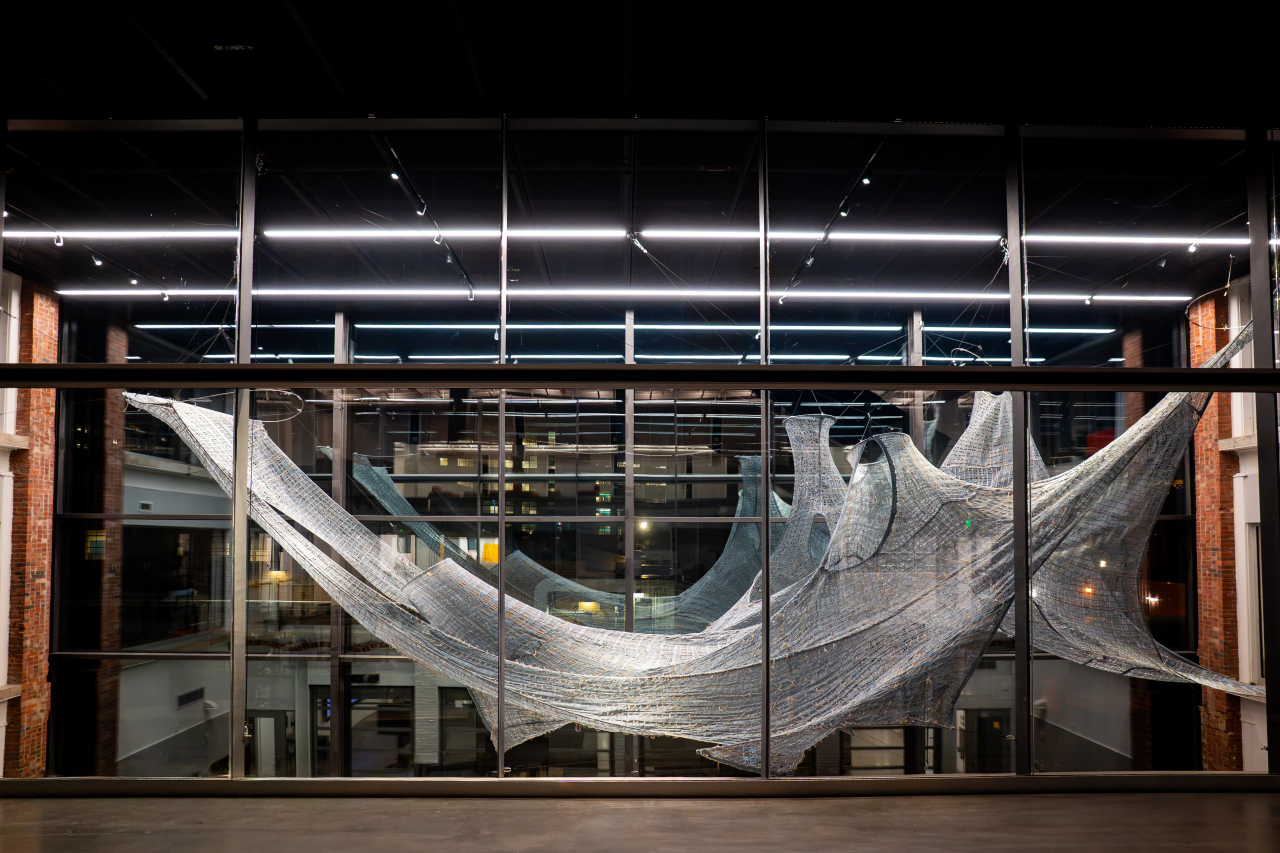
Necto is a 3D-knitted, anticlastic sculptural installation by Mariana Popescu, SO-IL, and TheGreenEyl. First exhibited at the 2025 Venice Architecture Biennale, the sculpture has been reimagined for the MET. Its flowing, luminous membrane, CNC-knitted from flax and linen, hangs, braces, and anchors within the MAD classroom, forming a cone, column, and hanging mass. Ninety-five percent biodegradable, it carries DNA-encoded material data and integrated light and sound, speculating on a future of intelligent, circular temporary architecture.
Unit 412, 2026
Carrie Norman
Assistant Professor,
MIT Architecture
Zaynab Eltaib
MArch ‘28,
MIT Architecture
Mara Jovanovic
MArch ‘26,
Teaching Fellow ‘26–27
MIT Architecture
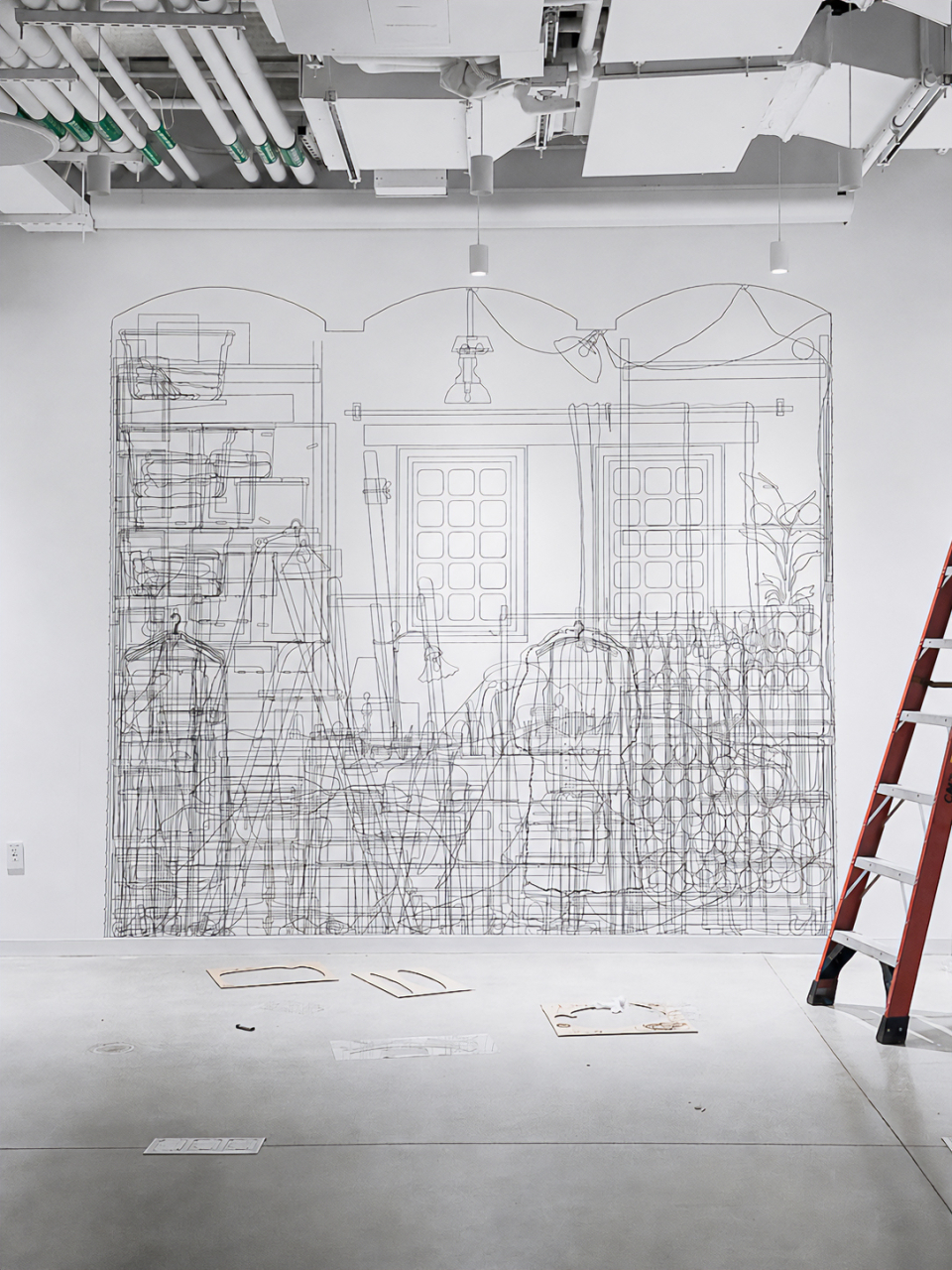
Combining archival research with local lore, Norman, Eltaib, and Jovanovic’s wall drawing imagines a storage unit’s contents across more than a century at the MET Warehouse. Drawn at full scale, overlapping outlines offer an X-ray view of objects accumulated over time, telling stories of class, culture, society, and human behavior. The contrast between technical precision and the imagined value of these tangible ghosts invites viewers to consider how and why we form attachments to objects, and how these objects anchor us, home and away.
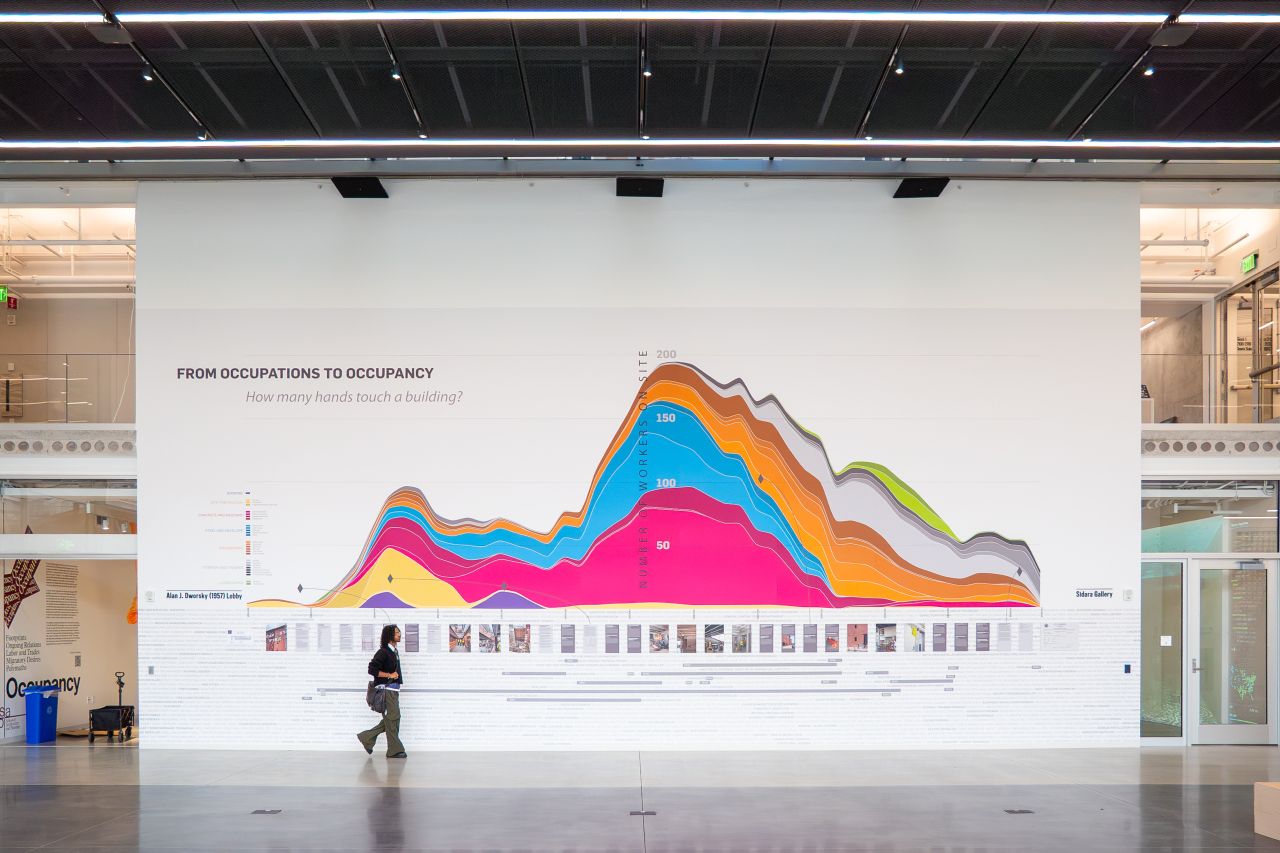
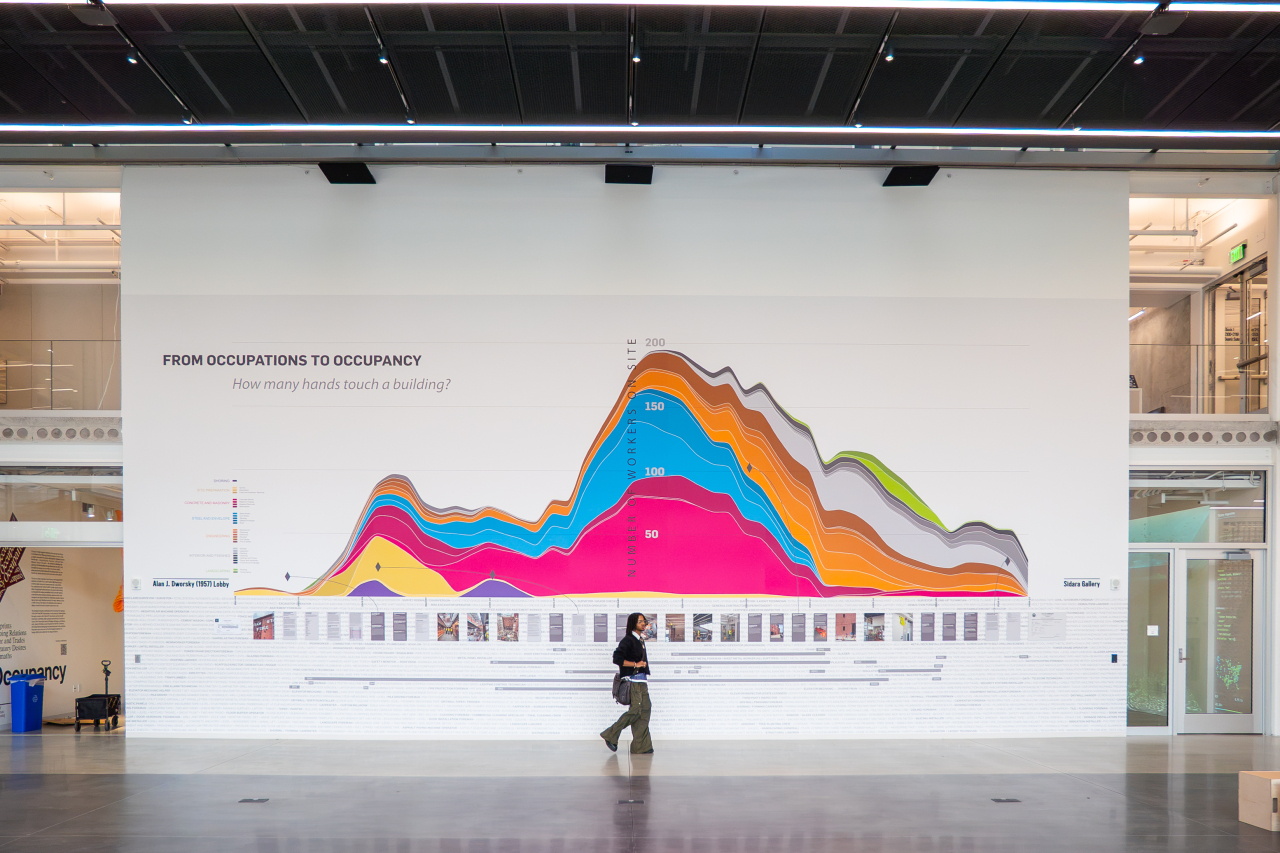
From Occupations to Occupancy: How Many Hands Touch a Building, 2026
Mark Jarzombek
Professor, MIT Architecture
Contributors
Rocio Crosetto Brizio
Maciej Dzumala
Avigail Gilad
Vivian Kinuthia
Paul Montie
Edward Yu
Jarzombek and his team’s experimental study of the multitudinous layers of construction labor highlights the complexity of the Metropolitan Storage Warehouse’s adaptive reuse as the School of Architecture and Planning. Taking the viewer from the moment building contractor Shawmut began surveying the existing site to the issuance of the certificate of Occupancy, Jarzombek and his team tell a moving story of wide-ranging problem solving, human effort, and labor, enriched with statistical analysis and anecdotal intricacy.
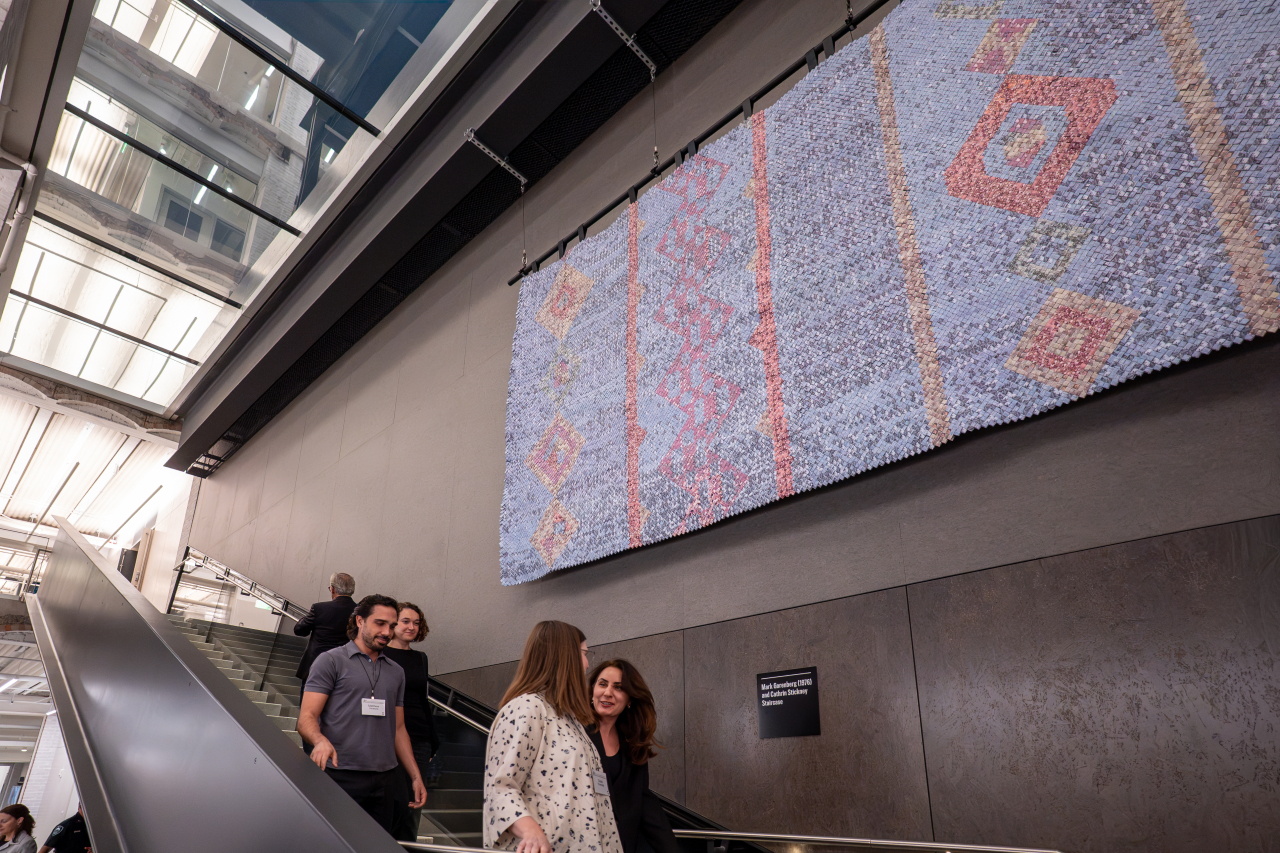
Distance Unknown: Visualizing Migration, 2026
Sarah Williams
Associate Professor, MIT Urban Studies and Planning; Director, Norman B. Leventhal Center for Advanced Urbanism
Contributors
MIT Civic Data Design Lab
Berit Lavender
Ashley Louie
Distance Unknown is an intricate, interwoven tapestry of multi-colored banknotes, where each color represents a different reason for migration in Central America. Aggregating personal accounts, economic metrics, and immigration data, Williams and her team represent the global forces driving economic growth and shaping production and consumption patterns, while illuminating migrants’ diverse lived experiences. Blue, representing economic motivations, dominates, followed by purple (security concerns), green (adverse climate events), yellow (quality of life), and orange (family reunification).
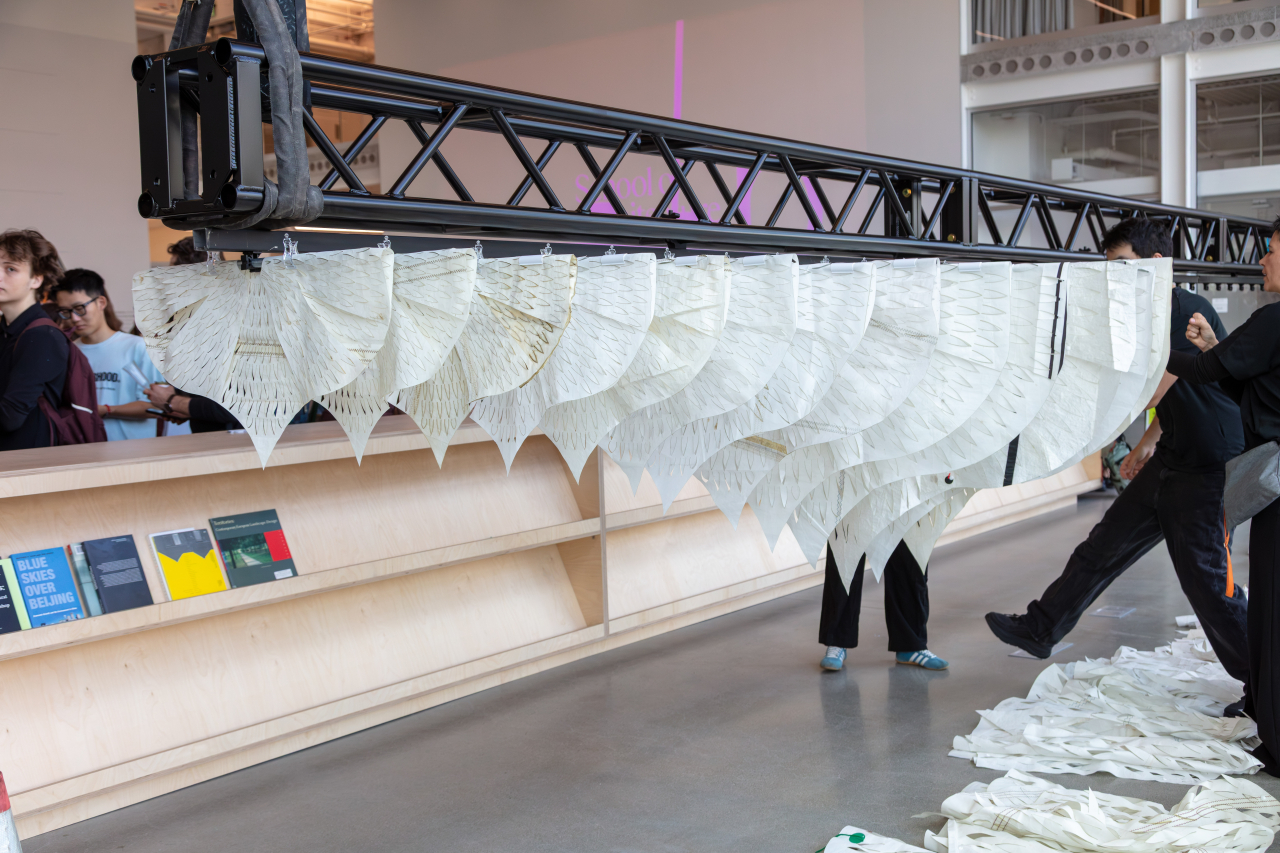
REEF II: Wake of the Living Bucentaur, 2026
Azra Akšamija
Professor and Director, MIT Art, Culture, and Technology program; Future Heritage Lab
Contributors
Performed by MIT
SA+P community
Sails donated by North Sails, Doyle Sails, and
Piers Park Sailing
Akšamija’s large-scale experiment in seaworthiness draws on the historic Bucentaur, the Venetian ducal barge MIT commissioned in 1916 to ferry its charter to its Cambridge campus. Convening participants from MIT and beyond, Akšamija collaboratively designed a performance piece: a ritual procession from Building 7 to the MET Warehouse in the shape of the Bucentaur. The sculpture renders human bodies in sailcloth and traces the vessel’s silhouette, evoking the flora and fauna of the surrounding landscape and marking SA+P’s homecoming.
Spectacles of Habitation, 2026
Azra Akšamija
Professor and Director, MIT Art, Culture, and Technology program; Future Heritage Lab
Contributors
Ya Gao
Penelope Phylactopoulos
Josie Stiver
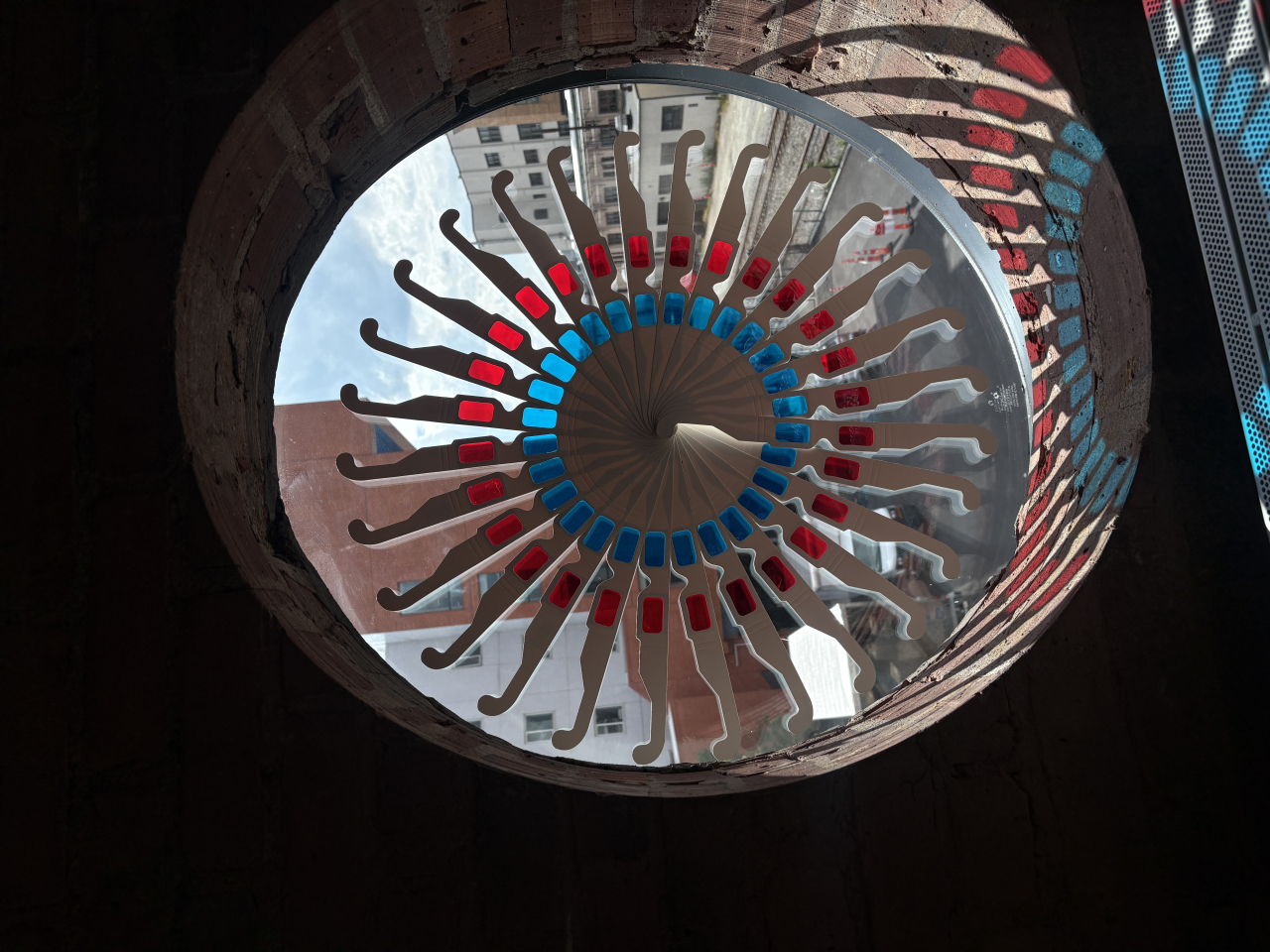
Akšamija’s pattern installations in the MET Lobby and Floor 3 Block 5 windows explore reuse through stained-glass-like interventions made of 3D glasses. Historically an arduous craft, stained glass marked a form of piety entwined with the church’s economic power, seeking to bathe believers in ethereal light. Through a hyperbolic, amusing quip on our contemporary world’s material oddities, Akšamija repurposes the inherently disposable object to evoke spiritual experience, engaging the imagination and expanding the possibilities of spatial adornment.
Presence Loop, 2025
Berfin Ataman
Researcher,
MIT Design Intelligence Lab
Presence Loop comprises a pair of kinetic sculptures that respond to sensor-collected temperature and motion readings from the MET’s internal environment. Embodying cyberneticist Gordon Pask’s theory of architectural mutualism, Ataman seeks to construct reciprocal paths and interactions between the building and those who inhabit it. The soft, pulsating movements evoke organic interstitiality, while the visible robotic forms of the sculptures close the loop between concealment and disclosure, allowing viewers to witness the mechanics of responsiveness rather than mistake it for magic.
Margins to Mainstream, 2025
Priyanka Salunkhe
Master in City Planning ‘27,
MIT Department of Urban Studies and Planning
Contributor
Larry Vale
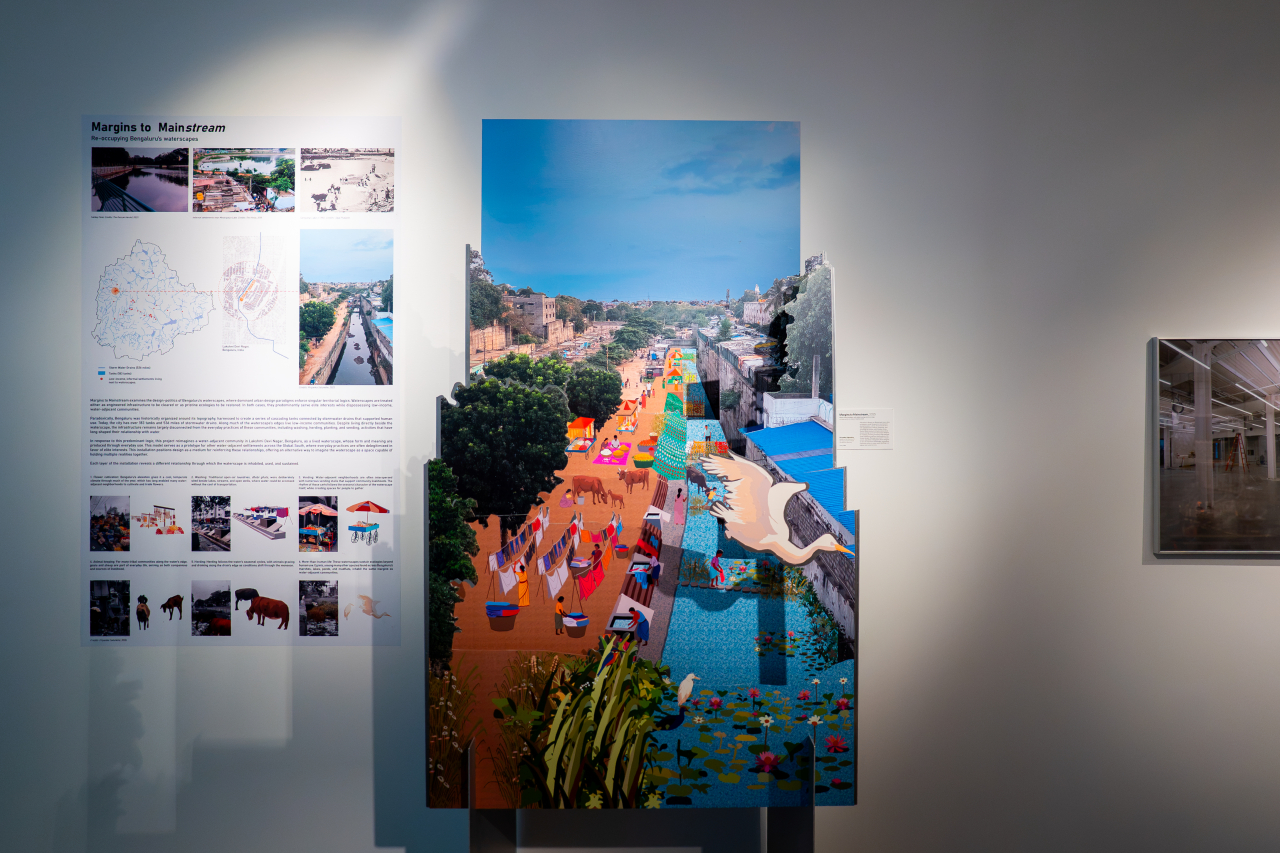
Salunkhe’s Margins to Mainstream traces how occupancy along Bengaluru’s stormwater drains becomes a form of movement in itself: communities shifting, adapting, and resettling in rhythm with climate cycles. Rather than residual infrastructure, these drains emerge as lived waterscapes shaped by washing, vending, herding, and seasonal reuse: adaptive practices long neglected by formal design. Through speculative visualization, Salunkhe reimagines these margins as sites of migratory knowledge, expanding equitable access to water amid shifting ecological and social terrain.
Housewarming, 2026
Junha Hwang
MArch ‘26; Teaching Fellow,
MIT Architecture
Vincent Jackow
MArch ‘26,
MIT Architecture
Contributors
xavi aguirre
Brandon Clifford
Carrie Norman
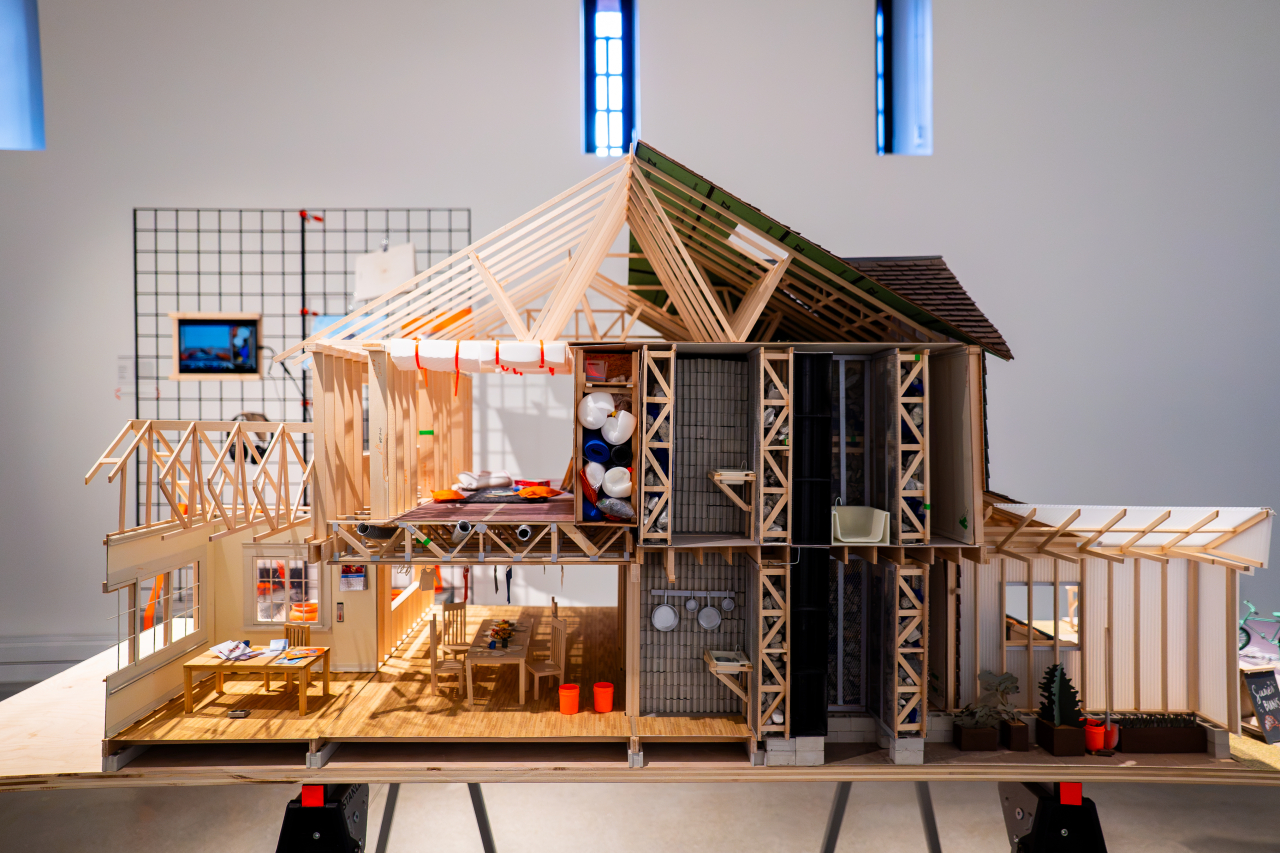
Housewarming interrogates architecture’s capacity to reclaim domestic comfort as a spatial, material, and collective practice amid climate and energy instability. Through 1:12 dollhouse models depicting incremental renovation across five decades from 2025 onward, and drawing on pre-industrial precedents like ondol systems and wind towers, it repositions the architect as “material diplomat, housekeeper, and house therapist” — apt for SA+P newly inhabiting its own structure. Resisting comfort’s outsourcing to energy-intensive appliances, it theorizes alternative systems that are inhabited and maintained, not mechanically delivered from scarce resources.
Geolectric, 2025
Marcelo Coelho
Associate Professor of the Practice, MIT Architecture;
Director, MIT Design Intelligence Lab
Contributors
Berfin Ataman
Nickolas Chelyapov
Jolyn He
Mona Li
Thomas Mgbor
Jacob Payne
Ishani Saraf
Geolectric is a design and research project that explores geopolymers as a sustainable alternative to materials conventionally used in consumer electronics. These inorganic, non-crystalline materials offer ceramic-like strength, durability, fire resistance, and thermal insulation, without requiring energy-intensive firing and significantly reducing emissions. The project demonstrates how embedded computing can be reimagined through materials that are locally sourced, derived from industrial byproducts, and aligned with circular economy principles, thus delivering small-footprint paths to occupancy.
Stone Holds, 2026
Ya Gao
MArch ‘28,
MIT Architecture
Catherine Yu
MArch ‘28,
MIT Architecture
Contributors
Christopher Dewart
Jess Osserman
Shah Paul
This series of furniture objects is developed through a system of interlocking plywood and steel components, celebrating the efficiency, precision, and material clarity of dry assembly. Stools, benches, and tables emerge from precise cuts and dry connections, assembled and disassembled without permanent fastening. The work responds to the school’s transitional move into the MET, where furniture allocation remains in flux. Designed for easy transport and reconfiguration, the series operates as both object and system; its logic found in the legibility and reversibility of its method.
Thirsty Algorithms, 2026
Sarah Williams
Associate Professor, MIT Urban Studies and Planning; Director, Norman B. Leventhal Center for Advanced Urbanism
Contributors
Maria Gabriela Carucci
Ata Chokhachian
Lake Heckaman
Berit Lavender
Ashley Louie
Sofia Medina
Gonzalo Portas
Maysaa Sati
Yufeng Zhao
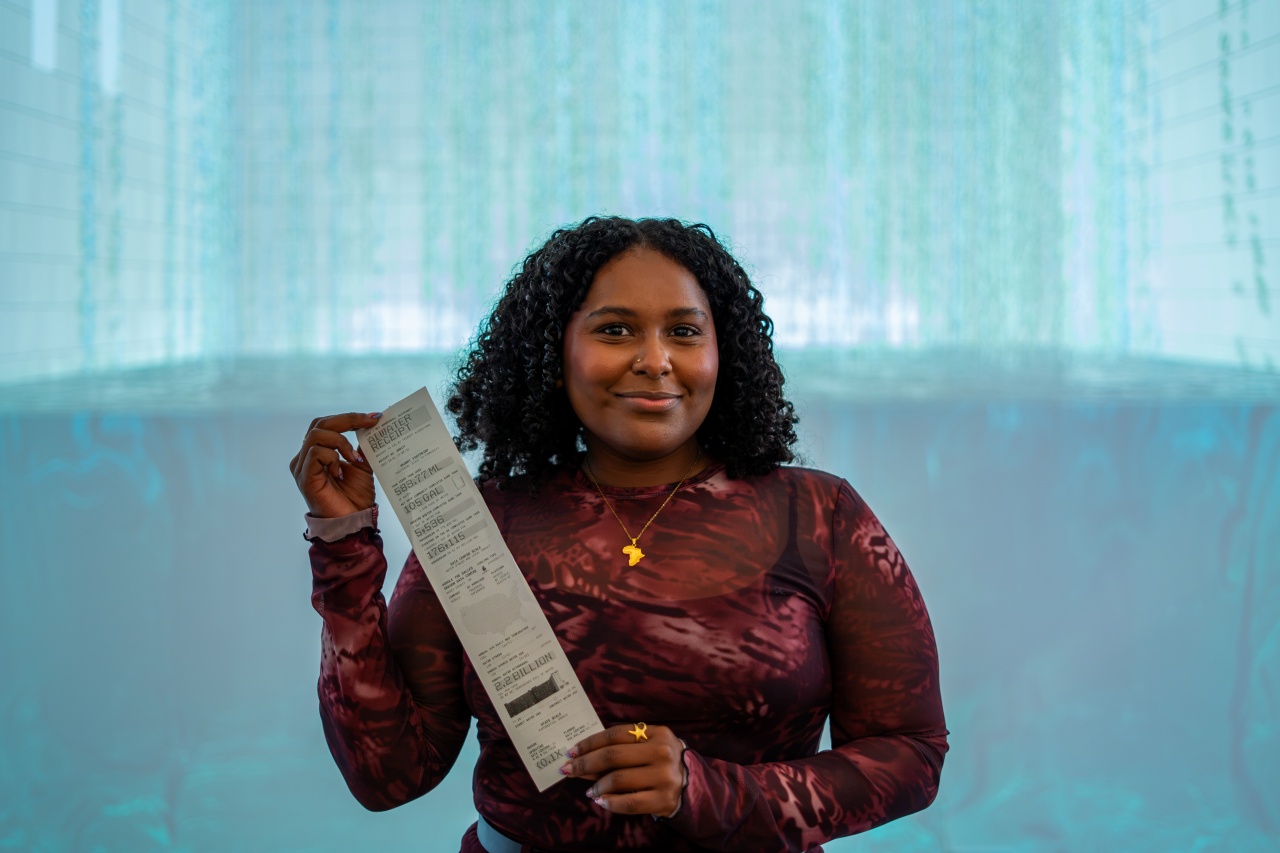
Artificial intelligence now underlies everyday work, communication, search, and decision-making processes, powered by vast, often opaque data centers that run continuously rather than activating per prompt. These facilities consume substantial energy and water. While a single AI interaction seems negligible, millions accumulate within infrastructure that never stops. Thirsty Algorithms makes visible this hidden relationship between everyday digital actions and the physical resources — energy, water, and constant computation — that sustain them, revealing the material cost behind seemingly weightless technology.
ElectroSPUN, 2026
Critical Matter Group
MIT Media Lab
Behnaz Farahi
Assistant Professor,
Media Arts and Sciences;
MAD Professor
Contributors
Yuxiang Cheng
Lauren Lee
Michelle Liang
Avantika Velho
Justin Wan
Annie Xing
Maggie Yan
Elijah Young
What if fibers could be spun directly into architectural membranes — without first becoming yarn or fabric? What if the MET Warehouse became a place where architecture grows? ElectroSPUN transforms excess seaweed into nanofibrous material through robotic electrospinning, creating lightweight membranes shaped by electric fields, material behavior, and geometry. At the nanoscale, variations in fiber density, orientation, and porosity generate gradients of translucency and light. Rather than assembling predefined components, ElectroSPUN treats architecture as growth and form-finding — biological matter, computation, and robotic fabrication converging into biodegradable spatial structures.
October 2026 – January 2027
Public hours
Monday–Friday
7am–7pm
Accessibility
The MET is wheelchair accessible. A step-free entrance is located on Massachusetts Avenue, with elevators providing access to all floors. Accessible restrooms are available near the building lobby.
For accessibility questions or to request an accommodation for an SA+P event, contact sap-info@mit.edu.
With contributions by
Merve Akdoğan, Azra Akšamija, Berfin Ataman, Dwai Banerjee, Gabriela Bila, Nickolas Chelyapov, Yuxiang Cheng, Marcelo Coelho, Jonny Cohen, Rocio Crosetto Brizio, Karilyn Crockett, Yolande Daniels, Catherine D’Ignazio, Valeria Doeñas, Fabio Duarte, Maciej Dzumala, Zaynab Eltaib, Behnaz Farahi, Ya Gao, Avigail Gilad, Rania Ghosn, Claire Gorman-Hanly, Marah Gubar, Melissa Gutierrez Soto, Jolyn He, Eakapob Huangthanapa, Monica Hutton, Junha Hwang, Vincent Jackow, Mark Jarzombek, El Hadi Jazairy, Mara Jovanovic, Emma Jurczynski, Karrie Karahalios, Vivian Kinuthia, Jean-Baptiste Labrune, Berit Lavender, Anhong Li, Mona Li, Ashley Louie, Thomas Mgbor, Ana Miljački, Paul Montie, Carrie Norman, Tanalís Padilla, Joe Paradiso, Jacob Payne, Penelope Phylactopoulos, Diogo Pinto, Ivan Ren, Nia Rich, Priyanka Salunkhe, Ishani Saraf, Andres Sevtsuk, Kye Shimisu, Anne Spirn, Josie Stiver, Avantika Velho, Justin Wan, Ben Weiss, Sarah Williams, Edward Yu, Catherine Yu
Labs and Groups
Critical Matter Group at MIT Media Lab, Future Heritage Lab, MIT Civic Data Design Lab